Managed operations for growing companies
Run your company the way you say you run it.
One layer between your people, your AI agents and your systems. Every action goes through it, gets checked against your rules, and gets logged.
For growing companies that run on SaaS and spreadsheets and don't want to become software companies. We build it, run it and keep it running.
- 09:14
approve_purchase_orderApprovedPO 2291 to Northline Packaging, $4,820
Rule: Purchasing v3 · approved vendor, under $5,000Ops · D. Chen
- 10:02
reconcile_invoicesReconciledOrder system and accounting disagreed on 3 invoices from yesterday
A missed update. Invoices re-posted; totals now match.
Rule: Order-to-cash v2 · nightly checkScheduled check
- 11:37
issue_creditEscalated · declined$1,250 account credit for Harbor & Co.
Declined by Maria: credit already issued on invoice 8841.
Rule: Credits v4 · over $150 escalatesSupport AI agent → Maria R.
Sound familiar?
Four things go wrong in every growing company.
Glue that breaks
The automations between your systems fail on every vendor change. You find out from a customer.
Rules nobody can enforce
Pricing limits, approval thresholds, exception policies — enforced by chat messages and memory.
Systems that disagree
Three systems, three different numbers. Reconciled by hand at close — after the decisions were already made.
No record
Finance reconstructs what happened. Nobody can say who approved what, under which rule.
What it is, and what it isn't
One layer, not another tool to configure.
Not an iPaaS you configure
We replace your Zapier or Workato flows and own them.
Not a dev shop
Nothing gets handed off at launch; it keeps running and is rebuilt as you change.
Not another AI bot
Your AI agents call us; we're where they're allowed to act.
Not a dashboard
Slack or Teams is the interface; finance gets a web view of the record.
What we promise
Stop the breaking. Enforce the rules. Keep the record.
- 01
Stop the breaking
Your integrations and internal tools become our responsibility — code, hosting, monitoring. When a vendor changes an API or you swap a system, it's our problem.
- 02
Enforce the rules
The rules everyone knows become rules that fire on every action, no matter who takes it.
- 03
Keep the record
Every approval, purchase, price change and override, with who did it and under which rule.
Most changes — a new rule, a vendor API change, a new system — are regenerated automatically and tested against your history before they go live. Our engineers handle the escalations, not the routine.
How it's built
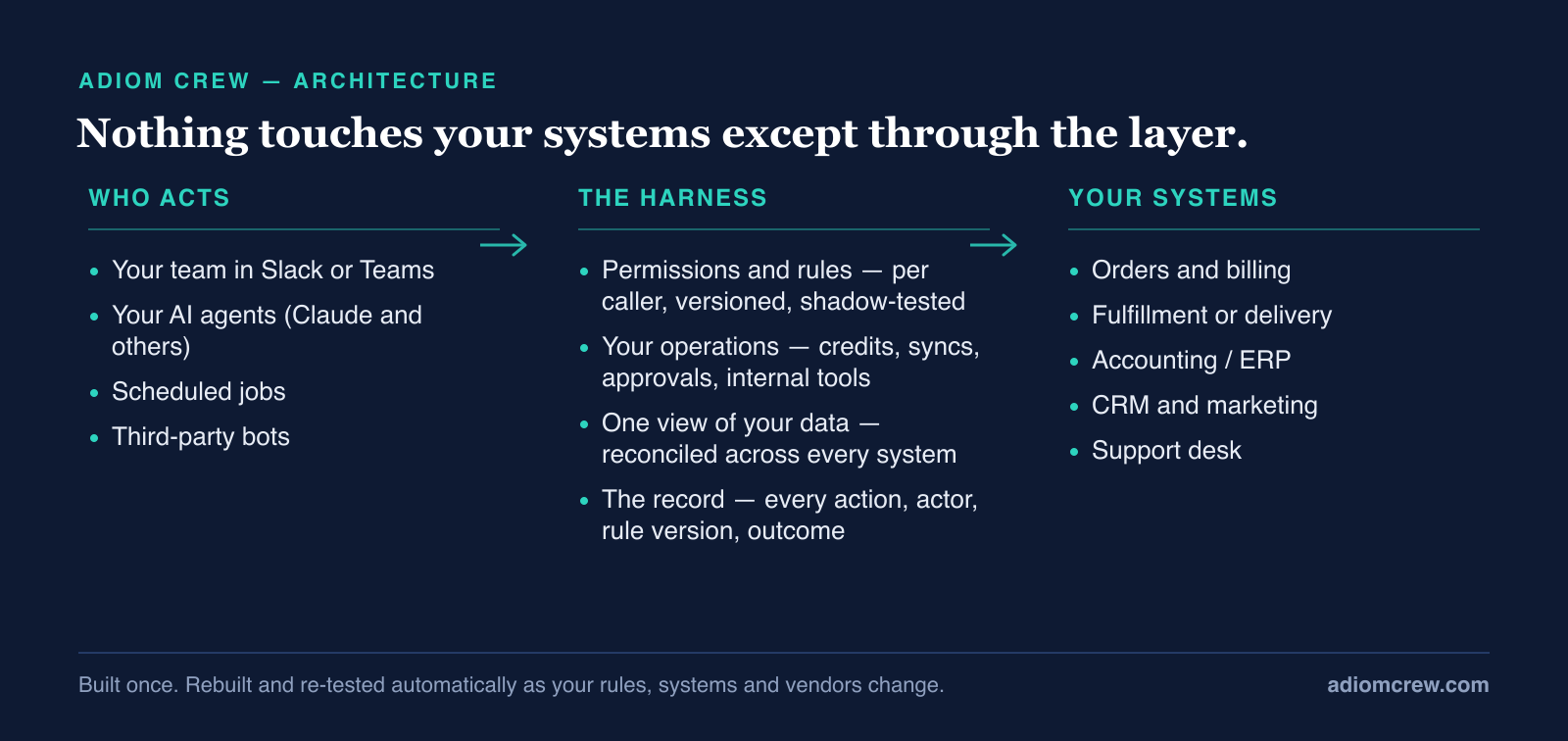
One layer between everyone who acts and every system you run.
Who acts
- Your team in Slack or Teams
- Your AI agents (Claude and others)
- Scheduled jobs
- Third-party bots
The harness
- Permissions and rules — per caller, versioned, shadow-tested
- Your operations — credits, syncs, approvals, internal tools
- One view of your data — reconciled across every system
- The record — every action, actor, rule version, outcome
Your systems
- Orders and billing
- Fulfillment or delivery
- Accounting / ERP
- CRM and marketing
- Support desk
Nothing touches your systems except through the layer.
Built once. Rebuilt and re-tested automatically as your rules, systems and vendors change.
Where we work
Find your industry.
We only list what we are actually doing today. Each industry gets its own page, written in its own language, with the systems and the fixes that come up every time.
Ecommerce & DTC
Shopify Plus, Amazon, your 3PL, NetSuite or QuickBooks, Klaviyo. Returns and refunds, inventory sync, reorder points, order-to-cash, wholesale pricing and promo limits.
See the stack and what we build first
How your AI agents use it
Bring your own AI agents. We're where they're allowed to act.
Your workflows, your bots, your scheduled jobs call the harness as a tool. Same rules, same record, per-caller permissions. An example, not a real customer:
- 01
The trigger
Your support AI agent tries to issue a $340 credit on account #48213.
- 02
The rule
Rule Credits v4 — over $150 escalates. Maria R. gets the Slack message with the account, the history and the rule. Taps Approve, adds a reason.
- 03
The record
The credit, its inputs, both actors — the AI agent and Maria — Credits v4, the outcome, Maria's reason.
When your team wants to use AI to do real work inside your systems, it goes through the same rules and the same record. That's what makes it safe.
How it works
One message shape, every time.
Something happened, here's what we propose, tap to approve, here's the log. No new tool to log into and no dashboard to check. See the first year, step by step.
You talk to us in Slack or Teams. We take responsibility for what happens next.
Adiom Crew1. Something happened
Accounting rejected 3 invoices overnight. The customer's billing address changed in the order system and never made it across.
Adiom Crew2. What we propose
Update the address in accounting and re-post the 3 invoices. Nothing else changes.
Dana · Ops3. Tap to approve
Approved
Adiom Crew4. Here's the log
Done. 3 invoices posted, totals match. Logged under Order-to-cash v2, approved by Dana.
Why us
Built by a team that companies like Zendesk and MongoDB trust with their data infrastructure.
Adiom's background is backends where downtime and data errors are existential: regulated healthcare, fintech, and the data layers of software companies at very large scale. Keeping systems in agreement, and proving what happened, is what we have done for years.
That discipline is now what we sell to operating companies: one team that runs the systems between your tools, keeps them agreeing with each other, and can show you the record. Everything we build for you stays yours.
Adiom is led by Alexander Komyagin, CEO, previously leading Product and Services at MongoDB, and Mark Chua, CTO, previously at Coinbase, Asana and Twitter. Both are based in San Francisco: a technical background in big-tech software, databases and data backends, and experience working with customers from startups and high-growth scale-ups to Fortune 500 companies, across a wide range of industries.
Book a 30-minute stack review.
We'll map your systems and tell you the first three things we'd fix. No pitch deck.