For ecommerce and DTC brands
Run your brand the way you say you run it.
We connect Shopify, your 3PL and NetSuite, make the integrations stop breaking, enforce the rules your team actually has, and keep a record of everything that happened — and we run it, so you never have to build an engineering team.
- 09:14
approve_refundApprovedRefund on order 48213, $86.40, damaged in transit
Rule: Refunds v4 · under $150, within 30 daysSupport · Jess
- 10:02
sync_inventoryReconciledShopify and ShipBob disagreed on 14 SKUs after yesterday's receiving
Counts corrected; 6 SKUs purchasable again.
Rule: Inventory drift · hourly checkScheduled check
- 11:37
approve_returnEscalated · declinedReturn on order 4890, $212, day 64
Declined by Maria: outside the return window. Store credit offered.
Rule: Returns v3 · over $150 or past 60 daysEscalated to Maria R.
Sound familiar?
Four things go wrong at every growing brand.
Glue that breaks
Zapier and Celigo flows fail on every Shopify or 3PL change. You find out from a customer.
Rules nobody can enforce
Discount limits, return windows, wholesale pricing — enforced by Slack messages.
Systems that disagree
Shopify, the 3PL and NetSuite give three inventory numbers. Oversells on one side, stockouts on the other, and close takes two weeks.
No record
Who approved that refund, under which policy? Nobody can say.
What it is, and what it isn't
One layer, not another tool to configure.
Not an iPaaS you configure
We replace your Zapier or Celigo flows and own them.
Not a dev shop
Nothing gets handed off at launch; it keeps running and is rebuilt as you change.
Not another AI bot
Your AI agents call us; we're where they're allowed to act.
Not a dashboard
Slack or Teams is the interface; finance gets a web view of the record.
What we promise
Stop the breaking. Enforce the rules. Keep the record.
- 01
Stop the breaking
Your integrations and internal tools become our responsibility — code, hosting, monitoring. Shopify changes its refund API on a Tuesday; you get a message saying the 40 refunds since 6am all landed in NetSuite, and nothing is needed from you. Swapping 3PLs is our project, not yours.
- 02
Enforce the rules
Refund limits, return windows, PO approvals and price changes become rules that fire on every action — whether it's support in Slack, a scheduled job or a new hire on day one.
- 03
Keep the record
Every refund, purchase order, price change and override, with who did it and under which rule. The question "who approved that?" takes one message to answer.
How it's built
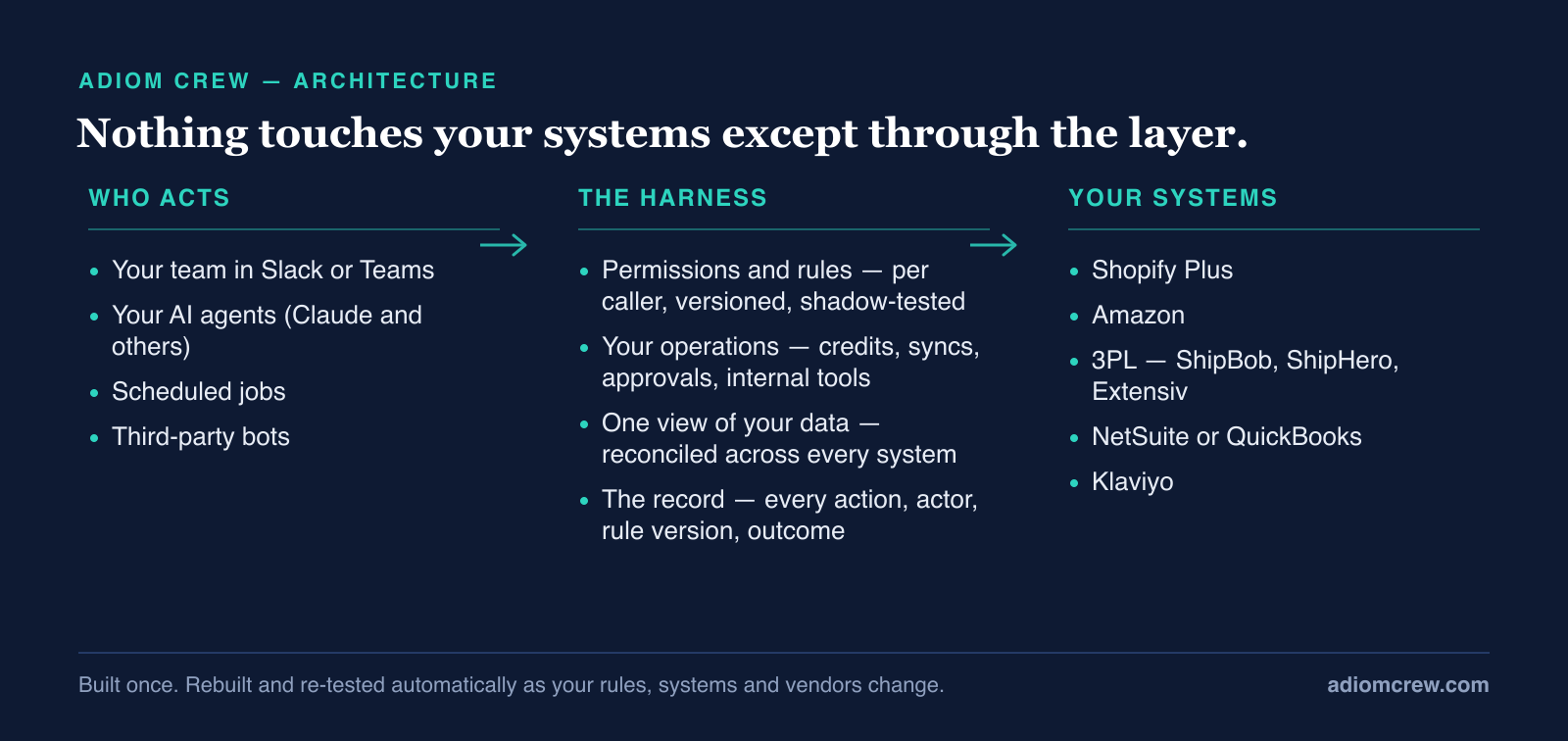
One layer between everyone who acts and every system you run.
Who acts
- Your team in Slack or Teams
- Your AI agents (Claude and others)
- Scheduled jobs
- Third-party bots
The harness
- Permissions and rules — per caller, versioned, shadow-tested
- Your operations — credits, syncs, approvals, internal tools
- One view of your data — reconciled across every system
- The record — every action, actor, rule version, outcome
Your systems
- Shopify Plus
- Amazon
- 3PL — ShipBob, ShipHero, Extensiv
- NetSuite or QuickBooks
- Klaviyo
Nothing touches your systems except through the layer.
Built once. Rebuilt and re-tested automatically as your rules, systems and vendors change.
How your AI agents use it
Bring your own AI agents. We're where they're allowed to act.
Your workflows, your bots, your scheduled jobs call the harness as a tool. Same rules, same record, per-caller permissions. An example, not a real customer:
- 01
The trigger
Your returns AI agent tries to refund $340 on order #48213.
- 02
The rule
Rule Refunds v4 — over $150 escalates. Maria R. gets the Slack message with the order, the customer history and the rule. Taps Approve, adds a reason.
- 03
The record
The refund, its inputs, both actors — the AI agent and Maria — Refunds v4, the outcome, Maria's reason.
When your team wants to use AI to do real work inside your systems, it goes through the same rules and the same record. That's what makes it safe.
The 90-day operations takeover
What's in the box.
A fixed-price, 90-day engagement that ends with your operations running on something you can trust, then a monthly subscription to keep it that way.
Takeover means we take the plumbing, not your people. Your ops manager still makes every call that needs a person — they just stop rebuilding flows at 11pm. You see everything, you can change any rule, and everything we build stays yours.
A stack audit
Every system, every integration, who owns it, and what breaks. In writing.
Fragile integrations replaced
Across Shopify Plus, your 3PL, NetSuite or QuickBooks, Amazon and Klaviyo — run in parallel with the old flow until the numbers match.
Your top 3–6 operations, built
Refunds, returns, inventory sync, reorders — whatever costs your team the most hours each week.
The rules you should have been enforcing
Written in plain English, tested against your own history, and switched on only after a shadow period.
The log and the Slack or Teams interface
Handed to you on day 90. Every action from then on is on the record.
The morning report
You pick the numbers in the takeover. They arrive in Slack every morning, the same shape every day — and when one moves because two systems disagreed, the report says which was wrong and who fixed it.
Then a monthly subscription
We keep running it, fix what breaks, and take on the next operations as you grow.
What we connect
The systems we work with.
- Storefront & marketplaces
- Shopify Plus
- Amazon
- ERP & accounting
- NetSuite
- QuickBooks
- Fulfillment
- ShipBob
- ShipHero
- Extensiv
- Marketing
- Klaviyo
- Where you talk to us
- Slack
- Microsoft Teams
If it's not here, or you have your own custom system, ask — we can make it happen.
The record
This is what you get to keep.
An example, not a real customer feed: every refund, sync and escalation, with the rule it ran under and the person who decided. When Maria declines a return, the reason is on the record — and it is how the rule gets better next quarter. How rules and the record work.
- 09:14
approve_refundApprovedRefund on order 48213, $86.40, damaged in transit
Rule: Refunds v4 · under $150, within 30 daysSupport · Jess
- 10:02
sync_inventoryReconciledShopify and ShipBob disagreed on 14 SKUs after yesterday's receiving
Counts corrected; 6 SKUs purchasable again.
Rule: Inventory drift · hourly checkScheduled check
- 11:37
approve_returnEscalated · declinedReturn on order 4890, $212, day 64
Declined by Maria: outside the return window. Store credit offered.
Rule: Returns v3 · over $150 or past 60 daysEscalated to Maria R.
The DTC operations library
What we usually build first.
Each one is built once for you, tested, and run with its rules and its log entries from day one.
Returns and refunds
Approvals under your policy, escalations with order history attached, and refunds that land in NetSuite.
Inventory sync and drift
One number for every SKU across Shopify, Amazon and the 3PL — and a message when they disagree, with the fix.
Reorder points
POs proposed off live sales across channels, not last week's export. You approve; the PO goes out.
Order-to-cash
Orders, payouts, fees and refunds reconciled into accounting every day, so close stops being a project.
Address and order edits
Changes made once and carried to the 3PL before the pick, with a record of who asked.
Wholesale pricing
Price lists and terms per account, enforced on every order rather than remembered.
Promo and discount limits
Codes and manual discounts checked against the ceiling you set, with overrides escalated.
Our track record
How we publish case studies.
Companies like Zendesk and MongoDB trust Adiom and our software with their data infrastructure — systems where a disagreement between two databases is an outage, not an inconvenience. Keeping systems in agreement and proving what happened is the work we have done for years.
Case studies publish as engagements complete: integrations replaced, rules enforced, and how many days came off the close. See customers.
Questions we get
Isn't this lock-in?
Everything we build for you is yours to keep, and you can take it with you at any time. What you'd leave behind is a running system with your rules and your history — which is the point of having it.
We already have Celigo.
It stays if it works. We take over what doesn't, and put the rules and the record on top of everything.
How is this different from an AI tool or Shopify Sidekick?
It isn't one. Sidekick governs Shopify; your rules span NetSuite, the 3PL, wholesale and finance. What you're buying is a team and the operating layer they run for you: the operations, rules and record that your staff and your AI agents both act through. An AI agent is only as safe as what it can touch, and this is what makes it safe.
Does this replace our ops manager?
No. It gives them the exception queue and the record instead of the plumbing. The person who approves the $340 refund is still yours — the thing that gets it to them is ours.
We're too small.
If you have fewer than ten integrations and nobody is losing sleep over them, you're right — and we'll say so on the call.
How much does it cost?
The 90-day takeover is a fixed price, and we quote it after the stack review, once we know how many systems and operations are in scope. How pricing works.
Is the morning report a dashboard?
No. A dashboard is somewhere you go. The morning report is something that arrives — a short message in Slack, not a screen to check.
We already have a reporting tool.
Keep it. We give you the reconciled numbers to feed it.
Book a 30-minute stack review.
Four questions about your stack, then pick a time with Alex. We'll map your systems and tell you the first three things we'd fix. No pitch deck.